Why Trump Flew to China with 18 CEOs
Trump’s China trip looked like a trade negotiation. But the bigger story may be about the foundations of a new global monetary order—and why gold could become the bridge between the world’s two largest economies.
Macrofinance
macrofinance.world
Trump’s China trip with 18 top U.S. CEOs may signal more than a tariff negotiation, as rising U.S. debt, China’s growing power, shifting energy flows, and surging gold demand put pressure on the global monetary system. One unproven theory is a “Plaza Accord 2.0,” where the dollar weakens against gold while China gains greater access to U.S. markets and investment. Whatever the outcome, China is becoming harder to exclude, gold is moving across borders, and the dollar-based financial system is evolving.
Why Trump Flew to China with 18 CEOs
Trump’s trip to China looked like a trade negotiation.
But there is a much bigger theory hiding underneath it.
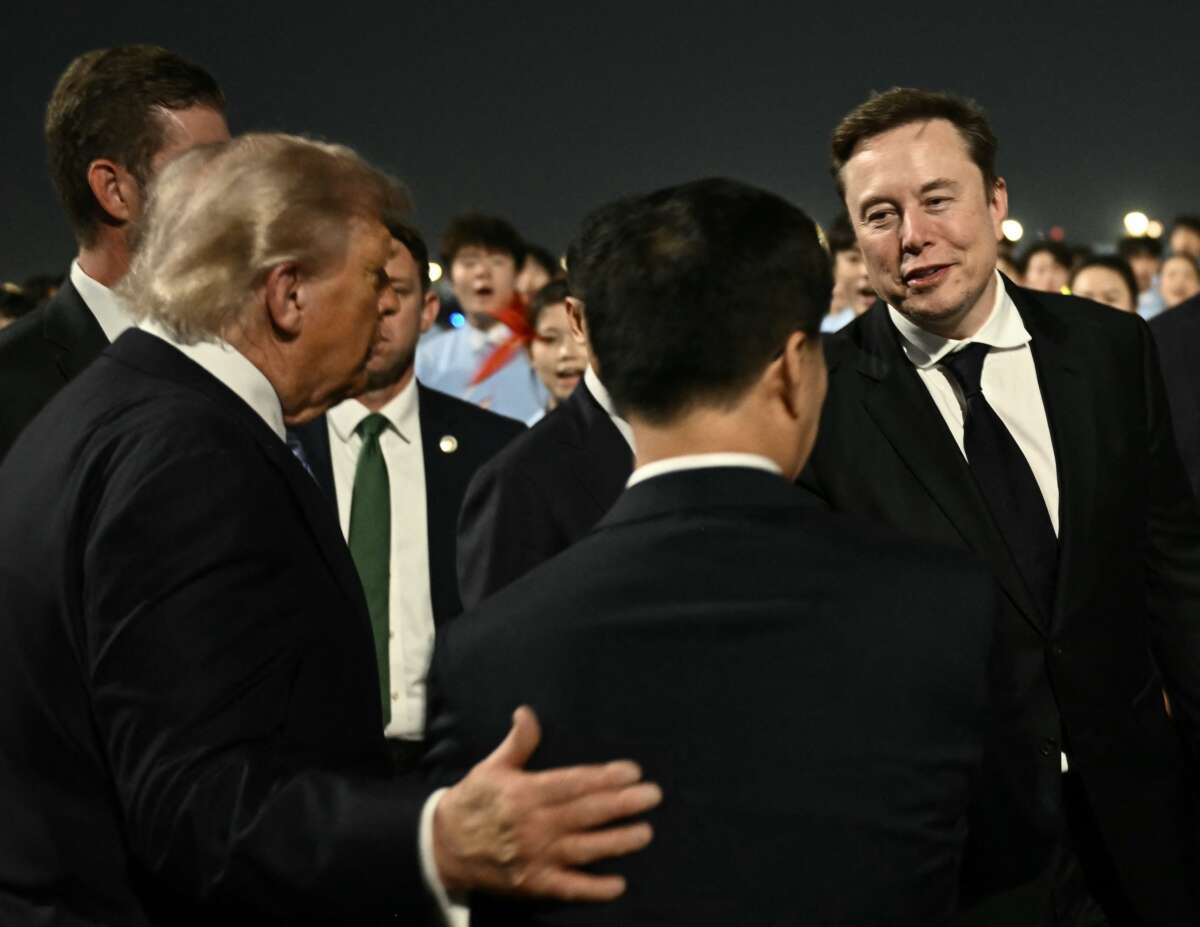
The President of the United States arrived in China alongside 18 of America’s most powerful business leaders — including Elon Musk, Tim Cook, Jensen Huang, and Larry Fink of BlackRock.
That is an extraordinary group to bring on a foreign trip.
And if the theory is correct, they were not there simply to negotiate tariffs.
They may have been there to negotiate the foundations of a new global monetary order.
The post-World War II financial system, built largely around American economic and monetary dominance, is under increasing pressure.
China has become too economically powerful to remain outside the conversation.
And one historical precedent makes this especially interesting:
The Plaza Accord.
---
The Deal That Changed the World
In 1985, the United States had a problem that sounds remarkably familiar today.
America was running a huge trade deficit.
The dollar was extremely strong.
And American manufacturers were struggling to compete against foreign producers.
So the Reagan administration brought together France, West Germany, Japan, and the United Kingdom at New York's Plaza Hotel.
Behind closed doors, they reached an agreement designed to weaken the US dollar against other major currencies, particularly the Japanese yen.
The strategy worked.
The yen appreciated dramatically.
Japanese exports became more expensive while American goods became cheaper by comparison.
America's manufacturing sector became more competitive and its trade deficit improved.
But there was a massive unintended consequence.
Japan's economy was heavily dependent on exports.
The rapid appreciation of the yen damaged its export competitiveness, so Japan responded by flooding the economy with cheap money.
That cheap money created one of the largest asset bubbles in modern history.
Japanese stocks and real estate exploded in value.
Then the bubble burst.
Japan entered what became known as its Lost Decades.
So why does a 40-year-old currency agreement matter today?
Because China has watched what happened to Japan.
And China is unlikely to make the same mistake.
---
China Doesn't Want Another Plaza Accord
The theory is that the real negotiation between Trump and Xi Jinping may not have been primarily about tariffs.
It may have been about something resembling Plaza Accord 2.0.
China itself reportedly proposed a major investment framework during negotiations in 2025.
But Beijing has no reason to simply allow its currency to appreciate dramatically against the dollar.
Japan already showed what can happen.
Instead, there is another possible escape valve:
Gold.
Rather than directly revaluing the yuan against the dollar, both countries could potentially allow the dollar to weaken against gold.
And if that happens, the consequences could extend far beyond the currency markets.
It could affect:
- The value of the dollar
- Inflation
- Government debt
- Gold
- Savings
- Investments
- The architecture of the global monetary system itself
---
The Thucydides Trap
Xi Jinping's opening remarks also referenced something called the Thucydides Trap.
The concept comes from the ancient Greek historian Thucydides, who studied the conflict between Athens and Sparta.
The basic idea is simple:
When a rising power begins challenging an established dominant power, the tension between them can eventually lead to war.
Historical research often cited around the concept has found that many transitions between dominant and rising powers have ended violently.
China knows it is becoming a superpower.
The United States knows it.
The question is whether the two countries can manage that transition without repeating history.
That makes the monetary relationship between the two countries particularly important.
---
The Strait of Hormuz Changes Everything
The monetary negotiations are happening against a much larger geopolitical backdrop.
The Strait of Hormuz is one of the most important energy chokepoints on Earth, carrying roughly one-fifth of global energy flows.
With the conflict involving Iran disrupting the strait, the world has been drawing down emergency oil inventories.
And the longer the disruption continues, the greater the pressure becomes on global energy markets.
That creates an unusual situation.
The official narrative may suggest that the crisis will eventually resolve and Hormuz will reopen.
But the physical energy data tells a more complicated story.
Inventories are being depleted.
Supply is tightening.
And some commodity analysts have warned that parts of Europe and Asia are already experiencing shortages.
The United States cannot simply replace all of the missing supply.
That means the longer the disruption continues, the more valuable China's position becomes.
And that gives Beijing leverage.
---
The Real Weapon May Be Oil
This is where the theory becomes particularly interesting.
The conflict is often presented as a straightforward confrontation involving Iran's nuclear ambitions.
But there is another interpretation.
China and Russia have enormous incentives to maintain economic pressure on the West without allowing the situation to escalate into a nuclear conflict.
A closed Strait of Hormuz can accomplish something similar.
It slowly drains global oil inventories.
It increases energy costs.
It pressures Western economies.
And it creates urgency for the United States to reach a broader agreement.
In that interpretation, Iran becomes less of the final objective and more of a geopolitical pressure point.
The longer the energy disruption continues, the greater the leverage becomes for countries sitting on the other side of the negotiation table.
And China now has enough economic power to demand a seat at that table.
---
Why Bring 18 CEOs?
This is where Trump's delegation becomes important.
If the objective were simply diplomatic negotiations, why bring an extraordinary collection of America's biggest corporate leaders?
Because the proposed solution may involve much more than currencies.
According to reports cited in the theory, China could potentially invest as much as $1 trillion into the United States, much of it directed toward factories, infrastructure, and manufacturing.
That sounds familiar.
It resembles what happened after the Plaza Accord.
Japanese companies such as Toyota, Honda, and Nissan expanded their manufacturing presence inside the United States.
The difference this time would be scale.
And the source of the capital would be China.
China could potentially receive greater access to the American consumer market.
The United States could receive:
- Factories
- Investment
- Jobs
- Industrial capacity
Both sides could claim victory.
But China would want something in return.
Potentially:
- Lower tariffs
- Greater access to American markets
- Reduced export restrictions
- Easier access to advanced technology
- Relief from sanctions
- Potentially concessions surrounding Taiwan
The trillion-dollar investment would therefore not be charity.
It would be a transaction.
China would be buying access, influence, and a seat at the table of the next global financial system.
---
Then There's Gold
This may be the most important part of the theory.
The United States officially holds more than 8,000 tonnes of gold.
But on the government's books, that gold is valued at only around $42 per ounce, a valuation dating back decades.
The market value is dramatically higher.
That creates a strange situation.
America technically owns a huge monetary asset, but its official balance sheet barely recognizes its current market value.
China, meanwhile, has been aggressively accumulating gold.
And there is another interesting development.
Physical gold has increasingly been flowing out of the United States toward international buyers, including China, sometimes through Switzerland.
Historically, gold flows have often accompanied shifts in monetary power.
As Britain's global dominance declined, gold flowed toward the United States.
By the end of World War II, America controlled more than half of the world's monetary gold.
And the country with the gold had enormous influence over the international monetary system.
So what if the current gold flows are telling us something?
---
A Gold-Based Plaza Accord
Imagine the following scenario.
China refuses to allow the yuan to appreciate dramatically against the dollar.
Instead, the dollar is allowed to weaken against gold.
The United States revalues its gold reserves closer to market prices.
Suddenly, the American government's balance sheet looks significantly stronger.
The real burden of America's enormous debt becomes easier to manage.
China's enormous gold holdings become dramatically more valuable.
And neither country has to directly force the yuan-dollar exchange rate into a destabilizing position.
At the same time, Chinese capital flows into American factories and infrastructure.
The United States gets investment and manufacturing.
China gets market access and influence.
And both countries get to claim that they have helped create a more stable relationship between the world's two largest economic powers.
That is the basic theory behind a potential Plaza Accord 2.0.
---
The Market May Already Be Pricing It In
There are also market movements that supporters of this theory point toward.
The dollar has been weakening against the Chinese yuan.
That is interesting because it is not necessarily what you would expect from a conflict supposedly designed to put economic pressure on China.
Chinese government bond yields have also remained comparatively low while borrowing costs have risen across several other major economies.
And then there is gold.
Gold has been surging.
Taken individually, none of these movements proves that a secret monetary agreement exists.
But together, they form what some investors describe as the "fingerprints" of a monetary transition.
The market can sometimes move before governments officially announce what they are doing.
---
The Real Goal May Be Inflation
There is another uncomfortable possibility.
Maybe inflation isn't merely an unfortunate side effect of this transition.
Maybe inflation is part of the solution.
America has accumulated nearly $40 trillion in government debt.
Paying that debt back becomes easier if the dollars used to repay it are worth less.
A dollar borrowed in 2020 can effectively be repaid with dollars in 2030 that have substantially less purchasing power.
Inflation reduces the real value of existing debt.
And that creates an unusual distributional effect.
People who own scarce assets can benefit.
- Stocks
- Real estate
- Gold
- Bitcoin
- Other scarce assets
Their nominal prices can rise alongside inflation.
But people whose wealth primarily exists as cash or fixed savings can lose purchasing power.
That creates what economists sometimes describe as a K-shaped economy.
The people who own assets move upward.
The people who don't can fall behind.
---
Add AI to the Equation
And this is where the monetary transition intersects with another enormous structural change:
Artificial intelligence.
AI and automation could dramatically increase productivity.
But they could also eliminate millions of jobs across areas such as:
- Customer service
- Data entry
- Trucking
- Manufacturing
- Warehousing
If productivity rises while employment falls, the economic gains will not necessarily be distributed evenly.
That could widen the existing divide between people who own productive assets and those who depend primarily on wages.
And if inflation is simultaneously reducing the purchasing power of cash savings, the divide becomes even larger.
This is the foundation of the broader theory surrounding a future financial system built around:
Digital identity + programmable money + increasingly centralized financial infrastructure
Whether that becomes a genuine control mechanism or simply a more efficient financial system remains an open question.
But the infrastructure is being developed.
---
The Dollar May Be Entering a New Era
The most important takeaway isn't necessarily that a secret deal has already been signed.
It hasn't been proven.
Hormuz could reopen.
The oil crisis could ease.
The gold theory could be completely wrong.
And there may never be a Plaza Accord 2.0.
But there is something much harder to ignore.
The global economic system is changing.
China has become too powerful to ignore.
America's debt burden has become too large to ignore.
Gold is moving across borders.
Energy flows are being disrupted.
Supply chains are being reorganized.
AI is transforming labor markets.
And the dollar's position in the global system is being questioned more openly than it has been in decades.
Trump bringing 18 of America's most powerful CEOs to China therefore may have been more significant than a normal trade delegation.
It could have been an early glimpse into negotiations over what comes next.
Not necessarily the end of the dollar.
Not necessarily the beginning of a Chinese monetary system.
But potentially the beginning of a new arrangement between the world's two largest economic powers.
And if the theory is right, gold could be the bridge between them.
---
The Bigger Question
The bigger question is what happens to everyone else.
Because if the dollar is deliberately weakened, inflation rises, AI restructures employment, and the global monetary system becomes increasingly digital, the biggest divide may no longer be between countries.
It may be between:
People who own scarce assets — and people who don't.
The monetary order is changing.
The question is who gets to write the rules.