They’re Using This Iran War to “Replace the Dollar”
The Iran war could be accelerating a transformation of the global monetary system. The dollar may not disappear—it could instead be rebuilt around stablecoins, tokenized assets, corporate wallets, and a new digital financial architecture.
Macrofinance
macrofinance.world
The conflict surrounding Iran could have consequences far beyond oil and geopolitics. A prolonged disruption of the Strait of Hormuz could push oil prices higher, increase Treasury yields, and intensify pressure on America's enormous debt burden. At the same time, stablecoins, tokenized assets, digital wallets, and artificial intelligence are creating the foundations for a new monetary architecture. The dollar may not ultimately be replaced by another currency—it may evolve into a more deeply embedded digital version of itself.
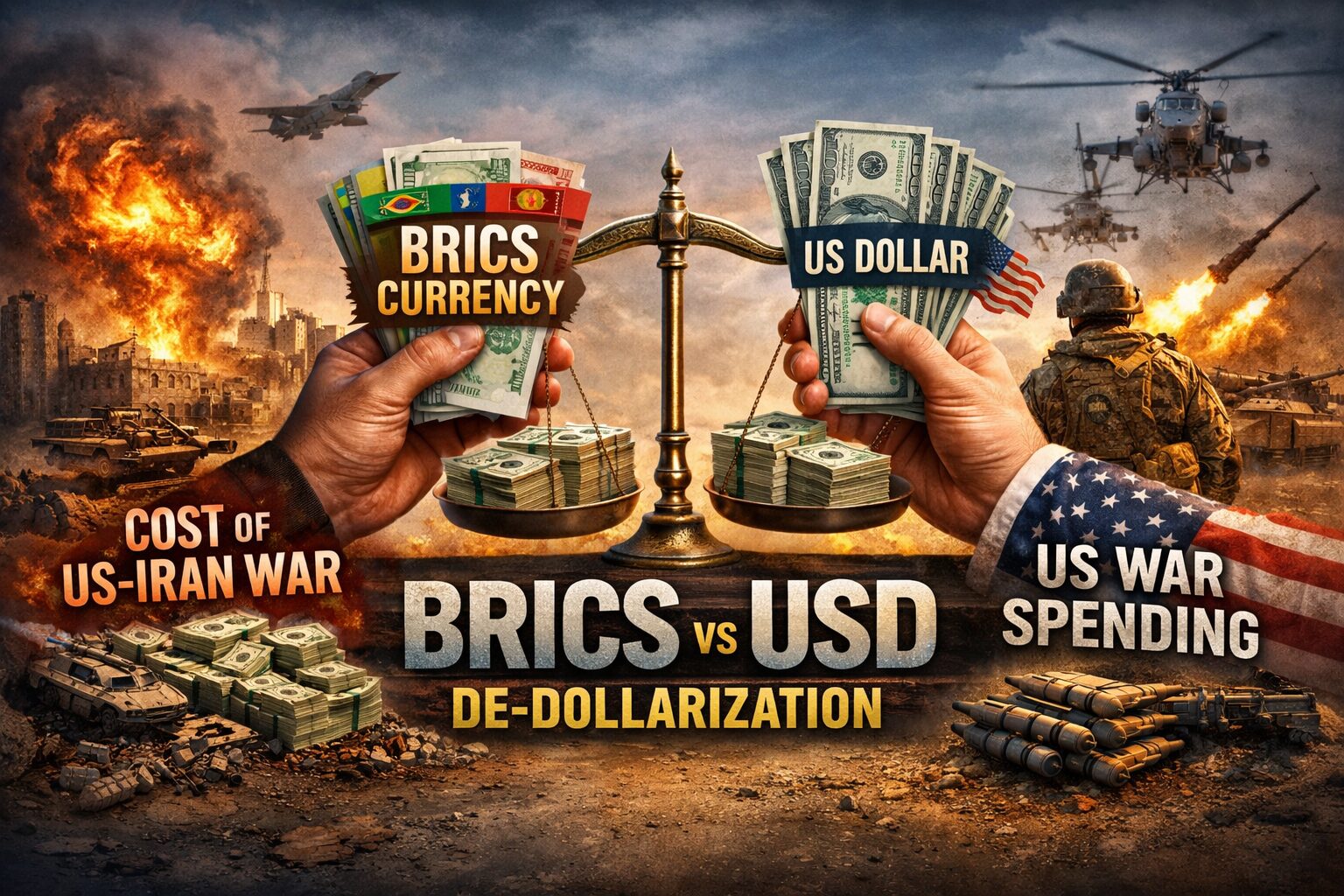
They’re Using This War to “Replace the Dollar”
The war in Iran may be about far more than Iran.
At first glance, the conflict looks like another geopolitical confrontation: the United States wants Iran to back down, Iran refuses, and the Strait of Hormuz becomes the central pressure point.
But look underneath the headlines and something much bigger starts to emerge.
The Strait of Hormuz is one of the most important energy chokepoints on Earth. Roughly 20 million barrels of oil pass through it every day. If the strait remains closed for long enough, the consequences won't stay confined to the Middle East.
Oil prices rise.
Inflation rises.
Treasury yields rise.
The cost of financing America's nearly $40 trillion debt rises.
And eventually, the entire global monetary system comes under pressure.
That is where this story gets interesting.
Because every major crisis creates an opportunity to change the system.
And this crisis may be creating an opportunity to accelerate a transition that has been developing for years: away from the traditional dollar-based financial system and toward a new digital monetary architecture.
The question is whether that transition happens accidentally—or whether powerful institutions are already preparing for it.
The Strait of Hormuz Is the Pressure Point
The most important thing to understand right now is the Strait of Hormuz.
It is a narrow waterway between Iran and the Arabian Peninsula, but its importance to the global economy is enormous.
Around a fifth of the world's oil supply normally passes through it.
And right now, tanker traffic has collapsed.
That creates an immediate problem.
Countries such as China, Japan, India, South Korea and many European economies still need oil.
But if the normal shipping route is disrupted, they have to compete for alternative supplies while paying significantly higher prices.
Oil becomes more expensive.
And because oil is still overwhelmingly priced in dollars, something unusual happens.
A global oil shock can initially increase demand for dollars.
But there's a second effect.
Countries that need dollars quickly may have to sell the dollar assets they already own.
That means selling US Treasuries.
And this is where America's balance sheet becomes important.
America's Hidden Vulnerability
One of the most important numbers in this entire story is America's net international investment position.
It measures the difference between the value of American assets owned abroad and foreign assets owned by Americans.
Today, the United States has a net international investment position of roughly -87% of GDP.
That is dramatically worse than where it stood after previous wars and crises.
After the first Gulf War, the figure was around -7%.
After the second Gulf War, it was around -12%.
After the 2008 financial crisis, it was still only around -15%.
Since then, America has continued selling assets to the rest of the world.
- Stocks.
- Real estate.
- Treasuries.
- Corporate assets.
Foreign investors have accumulated enormous amounts of American financial assets.
The result is that foreigners now own tens of trillions of dollars worth of US assets, including trillions in Treasury securities.
Normally, that isn't necessarily a problem.
But in a crisis, ownership becomes leverage.
If foreign governments suddenly need dollars to purchase energy, they can raise those dollars by selling their existing US assets.
And that's exactly where the pressure begins.
The Treasury Problem
When foreign governments sell Treasuries, Treasury prices fall.
When Treasury prices fall, yields rise.
And when yields rise, the cost of financing America's debt rises.
That matters because the United States is already carrying almost $40 trillion in federal debt.
The problem isn't simply the size of the debt.
It's the rate at which it is growing—and the interest cost associated with refinancing it.
Eventually, you can enter a feedback loop:
Higher yields → higher interest costs → larger deficits → more borrowing → more Treasury issuance → higher yields.
That's the debt death spiral.
And the longer an oil shock lasts, the greater the pressure becomes.
Some analysts have identified the area around 4.6–4.8% on the 10-year Treasury as a potential danger zone.
If yields move significantly higher from there, the consequences could spread across stocks, housing, consumer spending and government finances.
So the United States essentially faces three choices.
Three Ways This Can End
Option One: Let Yields Rise
The government could simply allow the bond market to function normally.
Treasury yields rise to 5%, 6%, or potentially higher.
That would make government borrowing more expensive.
It would also make bonds increasingly attractive relative to stocks.
Why take the risk of owning equities when you can potentially earn 5–6% from government debt?
Money would move out of risk assets.
- Stocks could fall.
- Housing could weaken.
- Consumer spending could slow.
- Banks could take losses.
- Tax revenues could decline.
- The larger US deficit could make the debt problem even worse.
Given America's enormous external liabilities, that kind of recession could spread internationally.
Not exactly an attractive outcome.
Option Two: Print Money
The second option is much more familiar.
The Federal Reserve steps in.
It buys Treasuries.
It injects liquidity.
It potentially caps yields through some form of yield-curve control.
In simple terms:
Money printer go brrr.
The problem is that this time, the economy could simultaneously be experiencing an oil shock.
That's a very different environment from 2008.
If you inject enormous amounts of liquidity into an economy while energy prices are exploding, you can get inflation instead of simply stabilizing the financial system.
And that creates the possibility of stagflation:
weak economic growth + high inflation.
That is one of the worst combinations an economy can face.
Option Three: Walk Away
The United States could simply declare victory and leave.
The war ends.
The Strait eventually reopens.
And everyone goes home.
On paper, that sounds like the easiest solution.
But there is another problem.
The rest of the world would have just watched the United States enter a war, fail to restore the shipping lane, and retreat.
That could fundamentally change perceptions of American power.
And this is where the comparison to Britain's Suez crisis becomes important.
America's “Suez Moment”
In 1956, Britain intervened in the Suez Crisis.
The United States opposed the operation and pressured Britain to withdraw.
Britain eventually did.
The episode became symbolic of the decline of British global power.
It was effectively the moment the world realized that Britain could no longer act as the unquestioned global hegemon.
Some analysts now ask whether Iran could become America's equivalent.
If the United States cannot restore order around one of the world's most important energy chokepoints, other countries may begin asking a dangerous question:
Why should we continue organizing our trade around the dollar if the United States can no longer guarantee the system behind it?
That could accelerate the move toward alternative currencies and payment systems.
And that brings us to the bigger story.
Every Crisis Creates an Opportunity
Throughout modern history, major crises have frequently resulted in greater centralization.
In 2008, the financial system nearly collapsed.
The response was unprecedented monetary intervention, including quantitative easing and massive support for financial institutions.
In 2020, a global pandemic shut down the world economy.
Within months, governments and institutions were openly discussing a "Great Reset."
The World Economic Forum described the pandemic as an opportunity to rethink and redesign the global system.
The pattern isn't necessarily evidence of a secret group planning every crisis.
It doesn't have to be.
The simpler explanation is that crises create conditions in which changes that would normally be politically impossible suddenly become acceptable.
People become willing to surrender more control in exchange for stability.
And that's what makes the current crisis so important.
Because the next monetary system may not look like the one we have today.
The Problem With the Existing System
The United States has two enormous structural problems.
The first is debt.
America has accumulated almost $40 trillion of federal debt, and that debt is growing faster than the economy.
The second is technology.
Artificial intelligence and automation could eventually displace enormous numbers of workers.
If AI becomes productive enough, the traditional relationship between employment and income could break down.
That raises an obvious question:
How does society distribute purchasing power when fewer people need to work?
One possible answer is some form of universal basic income.
But that creates another problem.
If governments are distributing money directly to citizens, the infrastructure through which that money moves becomes extraordinarily important.
And this is where digital money enters the picture.
The Next Monetary System Could Be Digital
Imagine a world where every major corporation has its own digital wallet.
Your airline has one.
Your supermarket has one.
Your phone company has one.
Your car company has one.
Your favorite retailer has one.
Instead of holding all your money in a traditional bank account, you increasingly hold digital dollars through companies and platforms you already use.
Those companies could then hold US Treasuries as the backing for the digital assets.
You receive:
- Rewards.
- Discounts.
- Interest.
- Charging credits.
- Cashback.
- Convenience.
The corporation gets an additional source of revenue.
And the US government gets something extremely valuable:
another buyer for its debt.
Scale that across billions of people and thousands of corporations and the system becomes enormous.
The United States would no longer have to rely exclusively on foreign governments and traditional financial institutions to absorb its debt.
The debt could increasingly be distributed throughout the global digital economy.
And stablecoins may already provide a blueprint for how this works.
Stablecoins Could Become the Distribution Layer
A stablecoin is essentially a digital asset designed to maintain a stable value relative to a currency, usually the US dollar.
The important part is what backs it.
Under proposed US legislation, stablecoin issuers can be required to hold highly liquid assets such as US Treasury securities against the tokens they issue.
That creates an interesting feedback loop:
People buy digital dollars → companies receive the dollars → companies buy Treasuries → Treasury demand increases → US debt gets absorbed.
Tether has already demonstrated how large this model can become.
It has accumulated well over $100 billion in US Treasury exposure.
Now imagine the same model integrated into the wallets of the world's largest corporations and technology platforms.
The result would be a global digital distribution network for US government debt.
And that is where the idea of replacing the dollar becomes more complicated.
The dollar may not actually disappear.
It could become more deeply embedded in the digital financial system.
From SWIFT to a Financial Control Grid
The current financial system already gives enormous power to whoever controls the infrastructure.
SWIFT can restrict access to international financial messaging.
Banks can freeze accounts.
Governments can impose sanctions.
But digital money introduces another level of control.
A programmable financial system could theoretically determine:
- Where money can be spent
- When it can be spent
- Who can receive it
- Whether a transaction is permitted
- Whether an account can be frozen
That doesn't mean governments will necessarily use those capabilities in the extreme ways critics imagine.
But the technical capability is what matters.
Once financial infrastructure becomes programmable, control becomes software.
And software can be changed instantly.
That's why critics of CBDCs and highly regulated stablecoins describe them as components of a potential financial control grid.
The argument is not necessarily that someone is going to turn off everyone's money tomorrow.
The argument is that the architecture could eventually make that possible.
Why Iran Matters
This brings us back to Iran.
Iran sits outside much of the Western financial system.
Its oil exports have increasingly involved alternative payment arrangements.
China is a major buyer of Iranian energy.
And the Strait of Hormuz gives Iran enormous leverage over global energy markets.
So Iran isn't simply another geopolitical opponent.
It sits at the intersection of three major systems:
- Energy
- Geopolitics
- Money
If the conflict permanently changes the way oil is traded, it could accelerate monetary fragmentation.
Countries could increasingly trade energy using currencies other than dollars.
That would weaken the traditional dollar system.
But paradoxically, the crisis could also create pressure for an entirely new dollar system—one based less on traditional banks and more on digital assets, stablecoins and corporate platforms.
That's the contradiction at the heart of this story.
The dollar may be weakening as the world's traditional reserve currency while simultaneously becoming more deeply embedded in the world's digital financial infrastructure.
The Dollar May Not Be Replaced—It May Be Rebuilt
This may ultimately be the most important distinction.
The next monetary system may not be:
Dollar → New Currency
It may instead be:
Physical cash + commercial banks + Treasury market → Digital dollars + stablecoins + tokenized assets + corporate wallets
The dollar doesn't necessarily have to disappear.
It can evolve.
And that evolution could allow the United States to maintain monetary influence even as foreign governments diversify away from traditional Treasury holdings.
The financial system could become less dependent on foreign central banks and more dependent on billions of individual users.
That would be an extraordinary transfer of financial architecture.
And potentially an extraordinary concentration of power.
What Happens Next?
Nobody knows exactly what the next crisis will be.
It could be:
- Prolonged inflation.
- Stagflation.
- A debt crisis.
- Another geopolitical conflict.
- An energy crisis.
- Or something completely unexpected.
But the underlying direction is worth watching.
The world is moving toward tokenized financial assets.
Stablecoins are growing.
Corporate digital wallets are becoming increasingly plausible.
Artificial intelligence is changing the labor market.
Government debt is becoming harder to manage.
And geopolitical fragmentation is encouraging countries to reconsider their dependence on the dollar.
These trends don't need to be part of one giant conspiracy to eventually converge.
They simply need to reinforce one another.
A crisis creates instability.
Instability creates demand for solutions.
Solutions require infrastructure.
And whoever controls that infrastructure gains enormous power.
What Does This Mean for Investors?
The biggest lesson may be that the traditional measurement system itself can change.
If the dollar loses purchasing power, stocks and real estate can rise in nominal dollar terms while investors become poorer in real terms.
That's why owning productive and scarce assets matters.
It also explains why gold continues to attract attention whenever confidence in monetary systems deteriorates.
Gold doesn't require a bank.
It doesn't require a network.
It doesn't require a government.
And it cannot be created with a keystroke.
Bitcoin presents a different version of the same argument.
Its appeal comes from self-custody and the possibility of owning an asset outside the traditional financial infrastructure.
Neither asset is guaranteed to protect wealth in every scenario.
But the principle is important:
Don't confuse a rising price with rising purchasing power.
The unit you're measuring wealth in matters.
And if that unit is being continuously debased, the numbers can become misleading.
The Bigger Picture
The real story may not be whether Iran wins or loses.
It may not even be whether the United States ultimately wins or loses the war.
The bigger question is what happens to the financial architecture after the crisis.
The old system was built around banks, Treasuries, SWIFT, physical currencies and central banks.
The emerging system could be built around stablecoins, tokenized assets, corporate wallets, artificial intelligence and digital identity.
That system could be dramatically more efficient.
It could make global payments faster and cheaper.
It could bring financial services to billions of people.
It could also create levels of financial surveillance and control that have never existed before.
Both things can be true.
And that's why the question isn't simply:
“Will the dollar survive?”
The more interesting question is:
“What does the dollar become?”
Because the next reserve currency may not be a new currency at all.
It may be a new version of the dollar—one embedded directly into the digital infrastructure of the global economy.
And if that happens, the war in Iran may ultimately be remembered not simply as a conflict over territory, oil, or nuclear weapons.
It may be remembered as one of the crises that accelerated the transition from the old monetary order to the next one.