Iran Was Never About Iran
The conflict surrounding Iran reaches far beyond nuclear weapons. Energy, China, the dollar, Israel, military power, AI, and digital financial infrastructure are all converging around one geopolitical fault line.
Macrofinance
macrofinance.world
The escalating conflict with Iran cannot be understood solely through the lens of nuclear weapons. Iran sits at the intersection of global energy markets, China's strategic ambitions, the dollar-based financial system, Israeli security interests, America's military-industrial complex, and the emerging digital infrastructure of modern warfare. As these forces converge, the conflict may represent something larger than a regional war—it may be an early battle over the infrastructure and leverage that will shape the next global order.
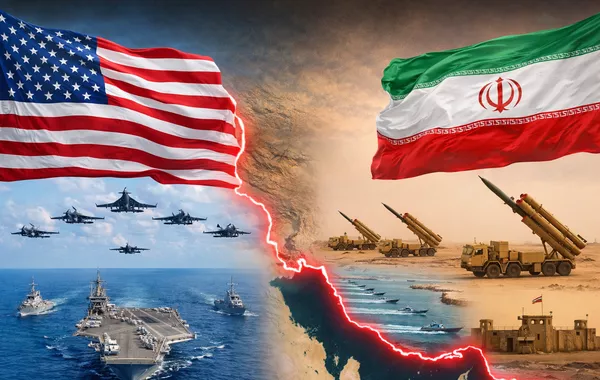
Iran Was Never About Iran
A few months ago, the idea that Iran could become the next major target in the escalating geopolitical conflict may have sounded extreme.
Now, the United States and its partners have launched Operation Epic Fury, one of the largest and most complex military offensives in the region.
The immediate question is obvious:
Why Iran?
The official explanation centers on Iran's nuclear program and the threat it allegedly posed to the United States and its allies.
But that explanation leaves a number of questions unanswered.
Iran had already agreed to nuclear inspections shortly before the latest escalation. Its nuclear infrastructure had also previously been targeted by the United States.
And according to congressional intelligence assessments cited in the debate, there was no evidence of an imminent Iranian attack against the United States.
So why escalate now?
The answer may have less to do with Iran itself than with what Iran represents.
Iran sits at the intersection of energy, China, the dollar, Israel, military power, and the emerging digital financial system.
And when those pieces are connected, the conflict starts to look very different.
The Four Power Players Behind the Conflict
There are several competing explanations for why the United States became involved in a direct confrontation with Iran.
None of them alone explains everything.
But together, they create a much larger picture.
Four major power centers stand out:
- Israel and the military-industrial complex
- The United States' strategic competition with China
- Financial, energy and defense interests
- The emerging technological and digital control infrastructure
Each has different motivations.
And each potentially benefits from a world in which Iran becomes weaker.
1. Israel Has Wanted Iran Contained for Decades
The first major theory begins with Israel.
Israel has viewed Iran as a strategic threat for decades, particularly because of its nuclear program, missile capabilities and support for regional proxy groups.
Benjamin Netanyahu has repeatedly warned that Iran was approaching the point where it could potentially develop a nuclear arsenal.
That argument has been made for years.
The timeline has repeatedly shifted, but the strategic objective has remained remarkably consistent:
Prevent Iran from becoming a nuclear power and, ultimately, weaken the Iranian regime.
The latest escalation therefore did not emerge from nowhere.
It is the culmination of a strategic project that has existed for decades.
One particularly important statement came from Marco Rubio, who explained that the United States knew Israel was preparing to act.
The logic was straightforward.
If Israel attacked Iran, Iran could retaliate against American military positions throughout the region.
From Washington's perspective, striking first could therefore be framed as a way to prevent a larger conflict later.
That creates an unusual dynamic.
The United States is not necessarily saying:
"We wanted this war."
The argument is closer to:
"The alternative was worse."
That distinction matters.
Because if Israeli military action was considered inevitable, Washington could portray American intervention as a preemptive measure rather than the beginning of a new war.
The Nuclear Question
The most controversial part of this argument involves Israel's nuclear capabilities.
Israel has never officially acknowledged possessing nuclear weapons.
However, many analysts and experts believe the country maintains a nuclear arsenal.
Former CIA officer John Kiriakou has claimed that Israel effectively presented Washington with an ultimatum: either the United States destroy Iran's deeply buried nuclear infrastructure, or Israel could escalate dramatically on its own.
That claim has not been independently verified.
But if true, the strategic implications would be enormous.
The United States could have been acting not simply to destroy Iran's nuclear program, but to prevent a potentially much larger regional or nuclear confrontation.
That would make Iran the battlefield.
But the underlying conflict would be between much larger strategic interests.
2. The China Connection
The second theory takes us far beyond the Middle East.
It takes us to Beijing.
The United States is increasingly treating China's rise as its primary long-term strategic challenge.
And Iran is deeply connected to China.
Iran possesses enormous energy resources.
China needs enormous amounts of energy.
That relationship matters.
If Iran can continue selling oil to China outside the traditional Western financial system, it provides Beijing with access to energy while reducing its dependence on American-controlled financial infrastructure.
That is precisely the kind of relationship Washington has an incentive to disrupt.
This is where the Strait of Hormuz becomes critical.
The Most Important Chokepoint in the World
The Strait of Hormuz is a narrow waterway separating Iran from the Arabian Peninsula.
But its importance is enormous.
A significant portion of the world's oil supply passes through it.
When the conflict intensified, shipping traffic through the Strait reportedly collapsed, leaving vessels stranded and insurance coverage disrupted.
That matters because modern global trade does not function without insurance.
A tanker can physically sail through a waterway.
But if insurers refuse to cover it, banks and shipping companies may refuse to finance or operate the voyage.
Insurance therefore becomes a kind of financial kill switch.
And once shipping becomes more difficult, the consequences spread quickly.
- Oil prices rise.
- Transportation costs increase.
- Energy-intensive industries face higher input costs.
- Consumers eventually feel the effects through fuel and transportation prices.
- Countries that rely heavily on imported energy become particularly vulnerable.
Why China Is So Important
China is one of the world's largest energy consumers.
It is also a major buyer of Iranian oil.
That creates a direct strategic relationship between Iran and China.
If Iranian oil becomes harder to export, China faces higher energy costs.
If oil prices rise globally, China also has to pay more for energy from other suppliers.
And if the United States can influence the world's major energy routes, it retains a form of geopolitical leverage that goes far beyond military power.
This is why the Strait of Hormuz matters.
Energy is leverage.
Whoever controls the supply of energy can influence the economic growth of countries that depend on it.
Higher Oil Prices Can Also Help American Energy Companies
There is another layer.
Higher oil prices are not universally bad for the United States.
America has become one of the world's largest oil and gas producers.
Companies such as ExxonMobil, Chevron and ConocoPhillips can benefit when crude prices rise, assuming their production costs remain relatively stable.
A higher selling price combined with relatively stable production costs means larger margins.
That creates a strange contradiction.
A geopolitical crisis can hurt American consumers while simultaneously benefiting American energy producers.
The same event can therefore produce winners and losers inside the same country.
And Then There Is the Dollar
Oil is still overwhelmingly priced and traded in dollars.
That matters.
If global oil prices rise, the global financial system requires more dollars to facilitate those transactions.
This can reinforce demand for the currency.
In other words, a geopolitical shock that pushes energy prices higher can potentially strengthen one of the pillars of the existing dollar-based financial system.
That is important because the dollar is already facing a structural challenge.
Countries are increasingly discussing diversification away from US Treasury assets.
Central banks are buying more gold.
China is developing payment infrastructure that operates outside traditional Western banking channels.
And alternative financial arrangements are becoming more important.
A stronger dollar system requires continued global demand for dollars.
Energy remains one of the biggest sources of that demand.
3. The Financial and Military Complex
The third theory concerns the financial, defense and energy interests surrounding American power.
Wars are not only geopolitical events.
They are economic events.
Military operations require enormous amounts of equipment.
- Aircraft.
- Missiles.
- Satellites.
- Drones.
- Intelligence systems.
- Cybersecurity.
- Logistics.
- Fuel.
- Communications infrastructure.
When these systems are deployed on a massive scale, the world gets to see American military technology operating in real conditions.
That is effectively a global demonstration.
War as a Product Demonstration
Imagine being a government watching the United States conduct a large-scale military operation.
You are not simply watching a war.
You are watching:
- B-2 bombers
- F-35s
- F-22s
- Tomahawk missiles
- Satellite systems
- Drones
- AI-powered intelligence
- Precision targeting
- Electronic warfare
Every country watching has to ask the same question:
Could we defend ourselves against this?
And if the answer is no, another question follows:
What would we need to buy?
That is where the defense industry benefits.
A military operation can therefore function as a live demonstration of capabilities worth billions of dollars.
The weapons being used today can become the products being purchased tomorrow.
Follow the Money
The financial incentives become even more interesting when looking at the network of political donors and business interests surrounding American power.
Major donors include people connected to:
- Finance
- Technology
- Defense
- Energy
- Aerospace
- Israel
- Hedge funds
- Infrastructure
This does not prove that these individuals caused the conflict.
That distinction is critical.
Political donations are not evidence of a conspiracy.
But they do reveal something important:
The groups with the most influence over American politics often have economic interests that intersect with the consequences of war.
Defense companies benefit from military spending.
Energy companies can benefit from higher oil prices.
Financial firms benefit from market volatility and capital flows.
Technology companies increasingly benefit from government contracts.
The interests overlap.
And when they overlap, geopolitical events can produce very different outcomes for different groups.
4. The Technology Layer
The fourth theory is perhaps the most consequential.
It has less to do with oil and more to do with technology.
For the first time in modern warfare, artificial intelligence is becoming directly integrated into military decision-making.
AI systems are increasingly being used for:
- Intelligence analysis
- Target identification
- Battle simulations
- Surveillance
- Logistics
- Decision support
That changes the nature of warfare.
A military that combines AI with satellites, drones, autonomous systems and massive computing infrastructure can process information at a speed humans simply cannot match.
And this is where Iran's conflict intersects with the technology industry.
When AI Starts Helping Plan Wars
Reports surrounding the conflict have highlighted the US military's use of AI systems to assist with military planning and intelligence.
One of the companies caught in the middle of this debate is Anthropic, the company behind Claude.
The dispute is not simply about whether AI should be used by governments.
It is about what governments should be allowed to do with AI.
Should AI systems be permitted to operate fully autonomous weapons?
Should they be used for mass surveillance?
Should private technology companies have the ability to refuse government requests?
These questions are no longer theoretical.
They are becoming part of national security policy.
And that creates a new relationship between Silicon Valley and Washington.
Say Yes to the Pentagon
The conflict between the US government and AI companies illustrates an emerging principle:
Technology is becoming strategic infrastructure.
Companies that provide artificial intelligence, cloud computing, chips, satellites and data infrastructure are no longer simply technology businesses.
They are increasingly part of national security.
That creates enormous incentives.
If a technology company cooperates with the government, it can gain access to major contracts.
If it refuses certain uses, it risks being treated as a national-security concern.
That relationship could shape the technology industry for decades.
The Digital Battlefield
Then something even more unusual happened.
Iranian retaliation reportedly targeted cloud infrastructure and data centers in the region.
That is significant because these facilities are not traditional military bases.
They are part of the digital infrastructure of the modern economy.
Banks rely on them.
Businesses rely on them.
Websites rely on them.
Governments rely on them.
Artificial intelligence systems rely on them.
Cloud computing is effectively becoming physical infrastructure.
And once that infrastructure becomes strategically important, it becomes a potential military target.
This is the beginning of something that could fundamentally change warfare.
The physical and digital worlds are merging.
The Beginning of Techno-Feudal Warfare?
Imagine a future conflict where:
- AI systems identify targets.
- Satellites provide surveillance.
- Algorithms analyze intelligence.
- Drones execute operations.
- Cloud servers coordinate infrastructure.
- Digital identities determine access.
- Financial systems restrict transactions.
The battlefield is no longer just land, sea and air.
It is also data, computing power, financial infrastructure and information networks.
That is why the Iran conflict could represent something much larger than another Middle Eastern war.
It could be an early example of what future geopolitical conflicts look like.
The Control Grid
This brings us to one of the most controversial theories surrounding the conflict.
The idea is that the world is moving toward a financial and technological control grid.
The theory is built around three components.
1. Programmable Money
Money that can contain rules.
Money that can potentially determine:
- Where it can be spent
- When it can be spent
- Who can use it
- What transactions are permitted
- Whether it can be frozen or restricted
2. Digital Identity
A financial system connected to digital identity.
That could include biometric authentication such as fingerprints, facial recognition or retinal identification.
3. Physical Infrastructure
The physical infrastructure required to operate the system:
- Data centers
- Satellites
- Fiber-optic networks
- Cloud infrastructure
- Cameras
- Telecommunications systems
Individually, none of these technologies is particularly unusual.
Together, however, they could create an entirely new financial architecture.
Why Iran Is a Problem for That System
Iran operates largely outside the Western financial system.
Its central bank is not integrated into the same financial architecture as major Western economies.
And Iranian oil exports to China can increasingly occur through arrangements that bypass traditional dollar-based infrastructure.
That creates a strategic problem for the existing system.
Because the issue is not simply:
Who controls Iran?
It is:
Who controls the infrastructure through which money moves?
If energy can be traded outside the dollar system, the dollar's role can weaken.
If financial assets can be tokenized, the architecture of ownership changes.
If digital identity becomes connected to financial access, the relationship between individuals and money changes.
And if governments and corporations control the infrastructure, financial power becomes increasingly centralized.
The Dollar's Last Frontier
This is where the Iran conflict connects to the broader transformation of the global monetary system.
The dollar is not disappearing overnight.
That would be unrealistic.
But the financial system around it is changing.
- Stablecoins are expanding.
- Financial assets are increasingly being discussed in terms of tokenization.
- Governments are exploring digital currencies.
- Banks are modernizing payment infrastructure.
- Companies are experimenting with blockchain-based financial systems.
BlackRock CEO Larry Fink has repeatedly discussed the potential for tokenizing financial assets.
The idea is straightforward:
Instead of financial assets existing primarily through traditional databases and intermediaries, stocks, bonds and other assets could eventually exist as digital tokens on shared ledgers.
That could make financial markets faster and more programmable.
But it also raises a much larger question:
Who controls the ledger?
From Money to Infrastructure
For centuries, financial power came from controlling banks.
Then it increasingly came from controlling payment networks.
Now it may come from controlling the infrastructure underneath those networks.
- Cloud computing.
- Data centers.
- Artificial intelligence.
- Satellites.
- Digital identity.
- Blockchain infrastructure.
- Stablecoins.
- Tokenized assets.
The companies controlling these systems could become as strategically important as traditional banks.
And that is why the technology industry is increasingly becoming intertwined with national security.
The Seven-Country Theory
There is another historical thread that continues to circulate in discussions about Iran.
In 2007, former NATO Supreme Commander General Wesley Clark described being shown a Pentagon memo outlining plans involving seven countries.
According to his account, the countries listed were:
- Iraq
- Syria
- Lebanon
- Libya
- Somalia
- Sudan
- Iran
The claim has become one of the most frequently cited pieces of evidence by people arguing that the current conflict was planned decades ago.
But it needs to be treated carefully.
The existence of a strategic memo does not automatically prove that every subsequent event was predetermined.
Geopolitical events are rarely that simple.
Governments change.
Leaders change.
Wars change.
Alliances change.
What the history does demonstrate, however, is that Iran has been viewed as a major strategic target within American foreign-policy circles for decades.
And now Iran is the final country on that list to become the center of a direct confrontation.
What Happens Next?
The most important question is no longer simply what happens to Iran.
It is what happens to the global system around it.
There are several possible consequences.
Oil
If the Strait of Hormuz remains disrupted, global energy prices could rise significantly.
That would increase inflationary pressure across the world.
China
China could face higher energy costs and greater pressure on its supply chains.
That could slow economic growth.
The Dollar
Higher energy prices can increase dollar demand because oil remains heavily dollar-denominated.
But prolonged geopolitical instability could simultaneously accelerate efforts by countries to diversify away from the dollar.
Defense
Military spending could rise as governments reassess their ability to defend against modern American weapons.
Technology
AI, cloud computing, autonomous weapons and surveillance technologies could become even more tightly integrated with national security.
Finance
Stablecoins, tokenized assets and digital identity systems could gain greater importance as governments seek more control and efficiency within the financial system.
The Bigger Picture
This is why the title matters.
Iran was never just about Iran.
Iran is a piece on a much larger geopolitical board.
It sits on some of the world's most important energy routes.
It has enormous oil and gas reserves.
It has deep economic relationships with China.
It has spent decades operating outside the Western financial system.
It sits next to the Strait of Hormuz.
And it represents a challenge to the existing US-led financial architecture.
At the same time, the conflict is accelerating the integration of technology and warfare.
AI is becoming part of military planning.
Cloud infrastructure is becoming strategically important.
Digital networks are becoming potential battlefields.
And financial infrastructure is becoming increasingly programmable.
These developments are happening simultaneously.
That is what makes the current moment so significant.
The Real Battle Is About Leverage
Ultimately, geopolitical power is not simply about territory.
It is about leverage.
Control the energy supply, and you gain leverage.
Control the financial system, and you gain leverage.
Control the payment infrastructure, and you gain leverage.
Control the technology, and you gain leverage.
Control the data, and you gain leverage.
And control the military systems that protect all of it, and you gain even more.
That is the larger story behind Iran.
The war may be fought over territory and nuclear facilities.
But the strategic competition underneath it is about who gets to control the infrastructure of the next global order.
The Next Global Order
The world is moving away from the simple model that dominated the post-Cold War era.
The United States remains the world's most powerful military and financial power.
But China is challenging its economic dominance.
Russia and other emerging powers are challenging the existing geopolitical structure.
BRICS countries are experimenting with alternatives to dollar-based trade.
Central banks are accumulating gold.
Technology companies are becoming geopolitical actors.
And governments are increasingly treating data, energy, AI and financial infrastructure as strategic assets.
That means the future may not belong to a single dominant power.
It may belong to whoever controls the systems that everyone else depends on.
And that is why Iran matters.
Not because Iran itself controls the world.
But because Iran sits directly on the fault line between the old system and the emerging one.
Bottom Line
The simplest explanation for the Iran conflict is that it is about nuclear weapons.
The broader explanation is far more complicated.
Israel has spent decades trying to contain Iran.
The United States has an increasingly urgent strategic competition with China.
China depends on energy from countries such as Iran.
The Strait of Hormuz gives Iran enormous leverage over global energy markets.
Higher oil prices can simultaneously hurt consumers, benefit energy producers and reinforce demand for dollars.
The military-industrial complex benefits from increased defense spending.
Technology companies are becoming integrated into national security.
And digital infrastructure is becoming part of the battlefield itself.
None of this proves that the conflict was secretly orchestrated by one group or that every event was predetermined.
But it does show that the incentives surrounding the war extend far beyond Iran's borders.
The deeper question is not simply who wins the war.
It is who controls the money, energy, technology and infrastructure of the world that comes after it.
Because if the global order really is changing, Iran may not be the destination.
It may be one of the last major pieces of the transition.