China Is Using Gold to Replace the U.S. Dollar
China is accumulating gold, expanding its bullion infrastructure, and promoting yuan-based trade as countries look for alternatives to the U.S. dollar. The strategy could reshape the global monetary system over the coming decade.
Macrofinance
macrofinance.world
China's growing gold reserves and expanding financial infrastructure suggest a long-term strategy to reduce global dependence on the U.S. dollar. While the dollar remains dominant today, gold-backed trade, BRICS cooperation, and changing reserve preferences could gradually reshape international finance.
A New Challenge to Dollar Dominance
For decades, the U.S. dollar has dominated global finance.
But China may be laying the groundwork for an alternative.
Over the past few years, Beijing has quietly:
- Bought record amounts of gold.
- Expanded the world's largest physical gold exchange.
- Built infrastructure that could allow countries to settle trade using gold-backed yuan instead of U.S. dollars.
If this strategy succeeds, it could become one of the biggest shifts in the global monetary system since the end of the gold standard.
The World Is Losing Trust in the Dollar
The catalyst wasn't just economics.
After the United States froze roughly $300 billion of Russia's foreign reserves in 2022, many countries realized something important.
If your reserves are held in dollars, they can potentially be frozen.
That sparked a global search for reserve assets that aren't dependent on another country's financial system.
The result:
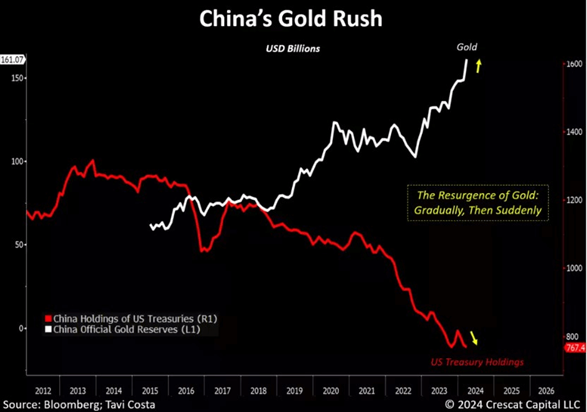
- Central banks began reducing Treasury holdings.
- Gold purchases accelerated to the fastest pace in modern history.
China has led much of that movement.
China's Gold Buying Spree
The People's Bank of China has become one of the world's largest gold buyers.
Official figures show holdings of roughly 2,300 tonnes.
Many analysts believe China's total holdings—including state-owned banks and sovereign funds—could be significantly higher.
At the same time, China has:
- Expanded the Shanghai Gold Exchange into the world's largest physical gold marketplace.
- Opened additional gold vaults in Hong Kong.
- Begun developing a "Gold Corridor" across BRICS nations.
This isn't simply about owning more gold.
It's about building an entirely new financial infrastructure.
What Is the Gold Corridor?
Think of it as a global network of interconnected gold vaults.
Instead of storing reserves exclusively in China, participating countries could hold verified gold across multiple locations while remaining connected through the Shanghai Gold Exchange.
Every gold bar can be tracked by:
- Ownership.
- Purity.
- Serial number.
This solves one of the biggest challenges in international finance:
Trust.
Countries no longer need to rely solely on China's promise.
They can independently verify and access their own reserves.
Gold Just Became Much More Important
A major regulatory change is helping this strategy.
Under Basel III banking rules, gold has been upgraded to a Tier 1 asset, allowing banks to recognize 100% of its value on their balance sheets.
Previously, gold received a significant valuation haircut.
Now it sits alongside the safest financial assets.
The next potential step is even bigger.
If gold eventually receives High-Quality Liquid Asset (HQLA) status, banks could use it as collateral for:
- Lending.
- Repo markets.
- Short-term funding.
That would transform gold from a passive reserve asset into active financial collateral.
Why This Matters for the Dollar
Today, U.S. Treasuries dominate global finance because they're widely accepted as premium collateral.
Countries needing liquidity often rely on Treasury-backed assets.
If gold achieves similar status, countries could finance trade and investment without depending on dollar-based collateral.
That would reduce one of the dollar's biggest structural advantages.
China's Bigger Goal
China isn't simply trying to make the yuan more popular.
It's trying to solve the reason many countries have hesitated to hold it.
Historically, governments have asked:
"If we hold yuan, what backs it?"
China's answer increasingly appears to be:
Gold.
By allowing participating countries to exchange yuan for physical gold stored across multiple vaults, China hopes to increase confidence in its currency.
Financing the Developing World
This strategy becomes even more powerful when combined with infrastructure lending.
Imagine a country rich in natural resources but lacking capital.
Instead of borrowing through Western institutions, it could:
- Deposit gold into China's network.
- Receive financing denominated in yuan.
- Build roads, ports, railways, or power plants.
- Repay loans while remaining largely outside the traditional dollar system.
This creates an alternative financial ecosystem centered around gold-backed collateral.
Why the U.S. Is Watching Closely
Gold has become strategically important again.
If countries increasingly demand physical collateral rather than paper assets, whoever controls and stores that collateral gains influence.
The United States still holds one of the world's largest official gold reserves.
Recent efforts to repatriate portions of U.S.-owned gold have fueled speculation that Washington also recognizes gold's growing strategic importance.
Whether that's the primary motivation remains debated.
But physical custody is becoming increasingly valuable.
Could Gold Prices Rise?
Many institutions currently allocate roughly 20% of reserve assets toward gold or similar hard assets.
Some analysts believe that allocation could eventually rise closer to 30%.
Across the global financial system, even a modest shift could create trillions of dollars in additional demand.
Unlike fiat currencies, gold supply cannot simply be expanded overnight.
If demand rises while supply remains relatively fixed, prices could face significant upward pressure.
Where Does Bitcoin Fit?
An interesting possibility is that the world doesn't move toward one replacement for the dollar.
Instead, two parallel systems could emerge.
One centered around:
- Gold.
- Physical collateral.
- BRICS nations.
- China's financial infrastructure.
Another centered around:
- Stablecoins.
- Tokenized assets.
- Digital finance.
- Bitcoin and blockchain networks.
Gold represents trust built over thousands of years.
Bitcoin represents trust built through cryptography and decentralized networks.
Rather than replacing one another, both could coexist in a more fragmented global monetary system.
Final Thoughts
China's strategy isn't simply about accumulating gold.
It's about rebuilding the infrastructure behind international finance.
If successful, countries may eventually gain an alternative to relying exclusively on the U.S. dollar for reserves, trade, and financing.
Whether that future ultimately revolves around gold, digital assets, or a combination of both remains uncertain.
But one thing is becoming increasingly clear:
The global monetary system may be entering its biggest transition in decades.